
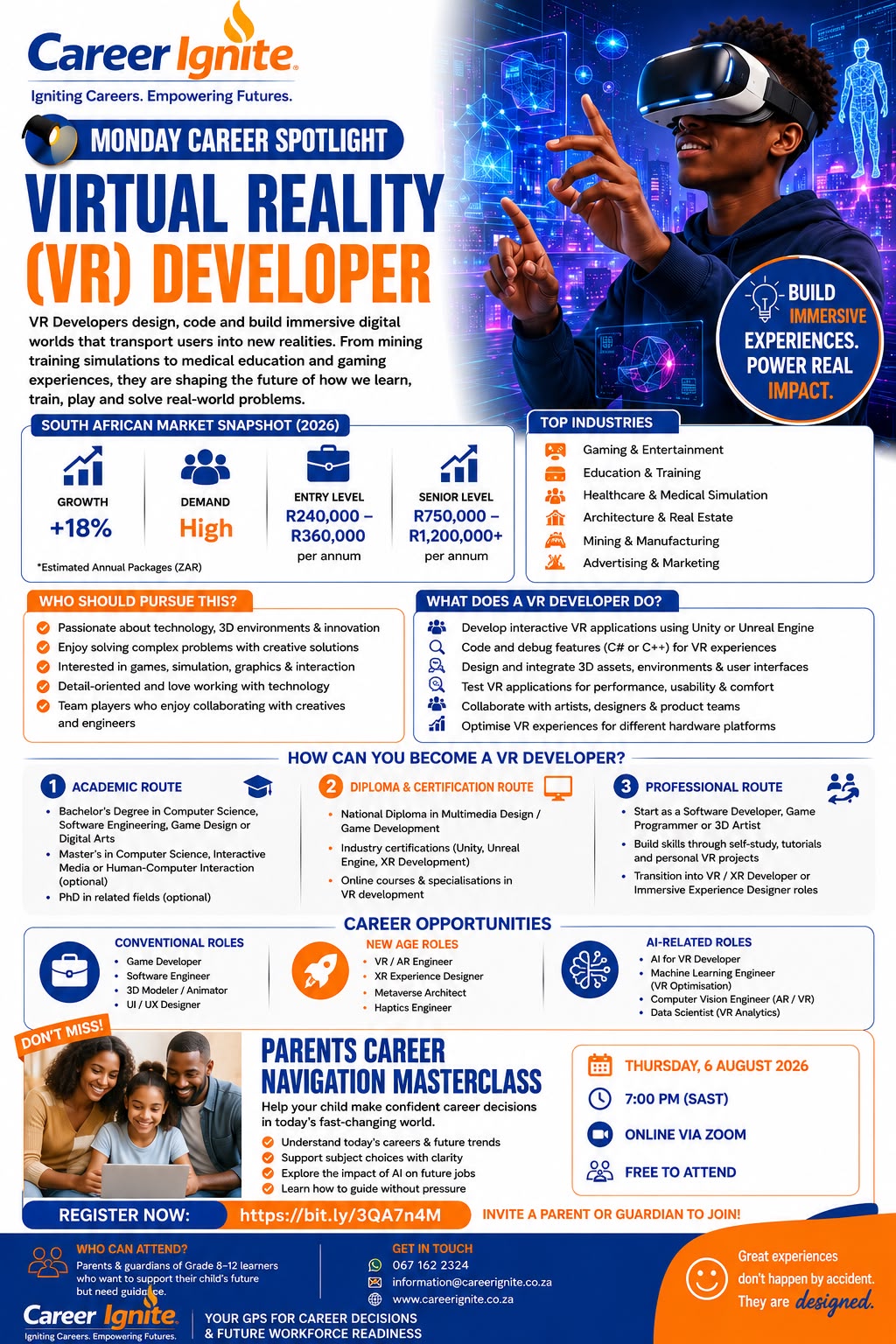
Virtual reality is no longer limited to gaming. It is being used to train employees, simulate medical procedures, visualise buildings, support education and create interactive customer experiences. A virtual reality (VR) developer helps build these computer-generated worlds and the interactions that make them feel convincing.
What does this professional do?
- Plans and develops interactive VR applications and simulations.
- Writes and tests code, often using game engines such as Unity or Unreal Engine.
- Combines 3D objects, sound, animation and user controls into one experience.
- Works with designers, artists, subject specialists and product teams.
- Tests performance, comfort, accessibility and usability across different devices.
Could this career suit you?
This path may appeal to learners who enjoy technology, visual creativity and solving complex problems. Patience matters because immersive applications require repeated testing. Collaboration is equally important: a strong VR product is rarely created by a programmer working alone.
Helpful school subjects
Mathematics, Information Technology, Computer Applications Technology, Engineering Graphics and Design, Visual Arts and Physical Sciences can all contribute, depending on the route. Learners should check the exact admission requirements of each institution before making subject decisions.
Study and development routes
Possible routes include computer science, software engineering, information technology, game design, digital arts, multimedia or interaction design. Wits, for example, combines engineering and creative production in its Digital Arts offering. Short courses and industry certifications can develop specific tools, but a portfolio of working projects is essential. Start with a small 3D scene, interactive educational experience or simple game and document how it was designed and tested.
South African career outlook
VR skills can be applied in gaming, education, healthcare, architecture, mining, manufacturing, marketing and training. Job titles may include VR developer, XR developer, immersive experience designer, game developer, simulation developer or 3D technical artist. Because titles differ between employers, search for the skills and work as well as the exact job name.
Related careers to explore
Game Developer; Software Developer; UX Designer; 3D Artist; AR/XR Developer; Simulation Developer; Computer Vision Engineer.
Career Quest question
Would you enjoy combining code, design and imagination to create a world that people can step into?
Sources and editorial references
- University of the Witwatersrand: Undergraduate courses in Digital Arts. https://www.wits.ac.za/wsoa/digital-arts/undergraduate/
Editorial note: precise salary and growth figures have deliberately not been published as facts without a named, dated source. Career opportunities and admission requirements change; readers should verify current information with employers and institutions. Information reviewed 29 August 2026.
Laiqah Bowers-Charles
Founder & CEO, Career Ignite
- • Certified Career Counsellor
- • Certified Career Assessment Practitioner
- • 25+ Years HR & Human Capital Leadership
Not sure whether this is your best-fit career?
A career should not be selected only because it appears exciting, pays well or is described as “in demand”. Career Ignite helps learners explore the relationship between their interests, personality, abilities, motivators and possible career environments.
Related articles
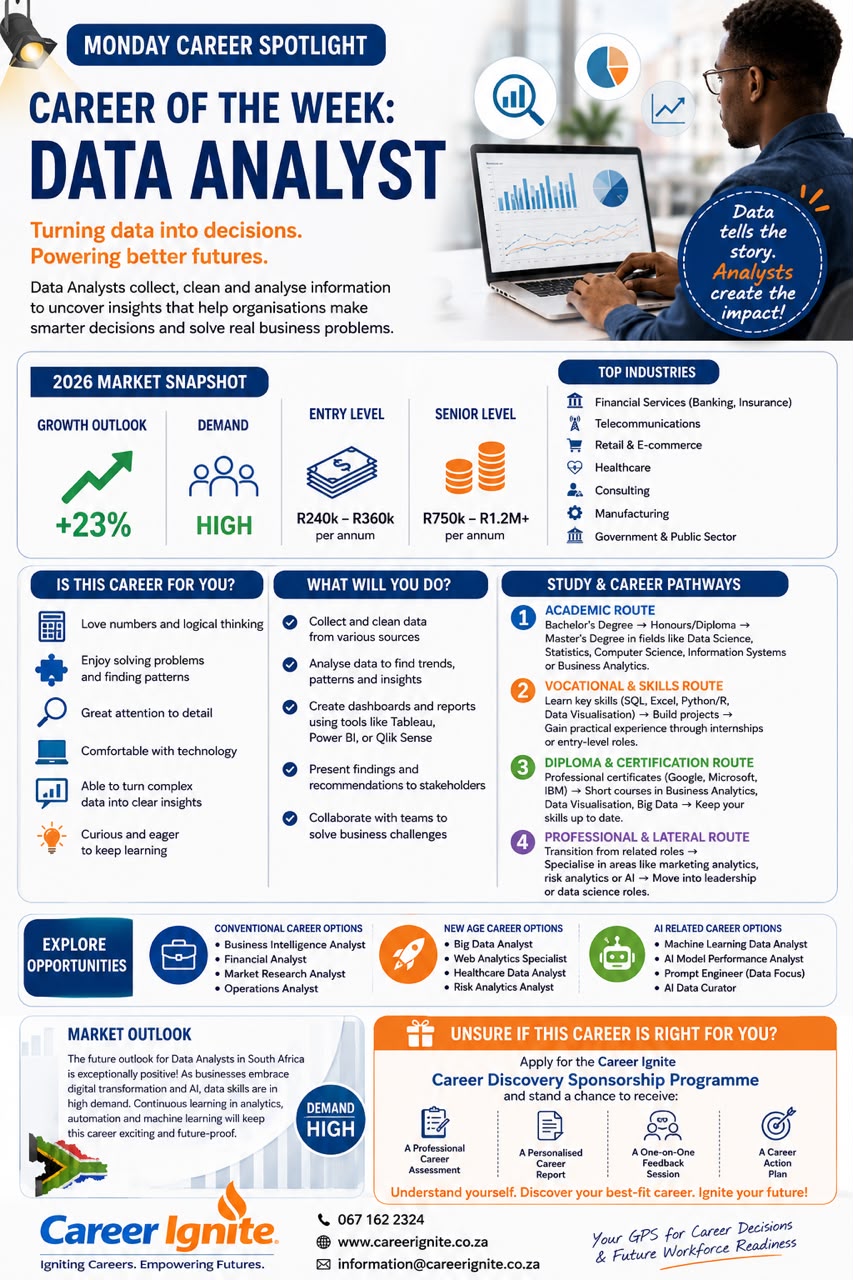
Learn how data analysts turn raw information into useful insights and what learners can do to begin building relevant skills.
Read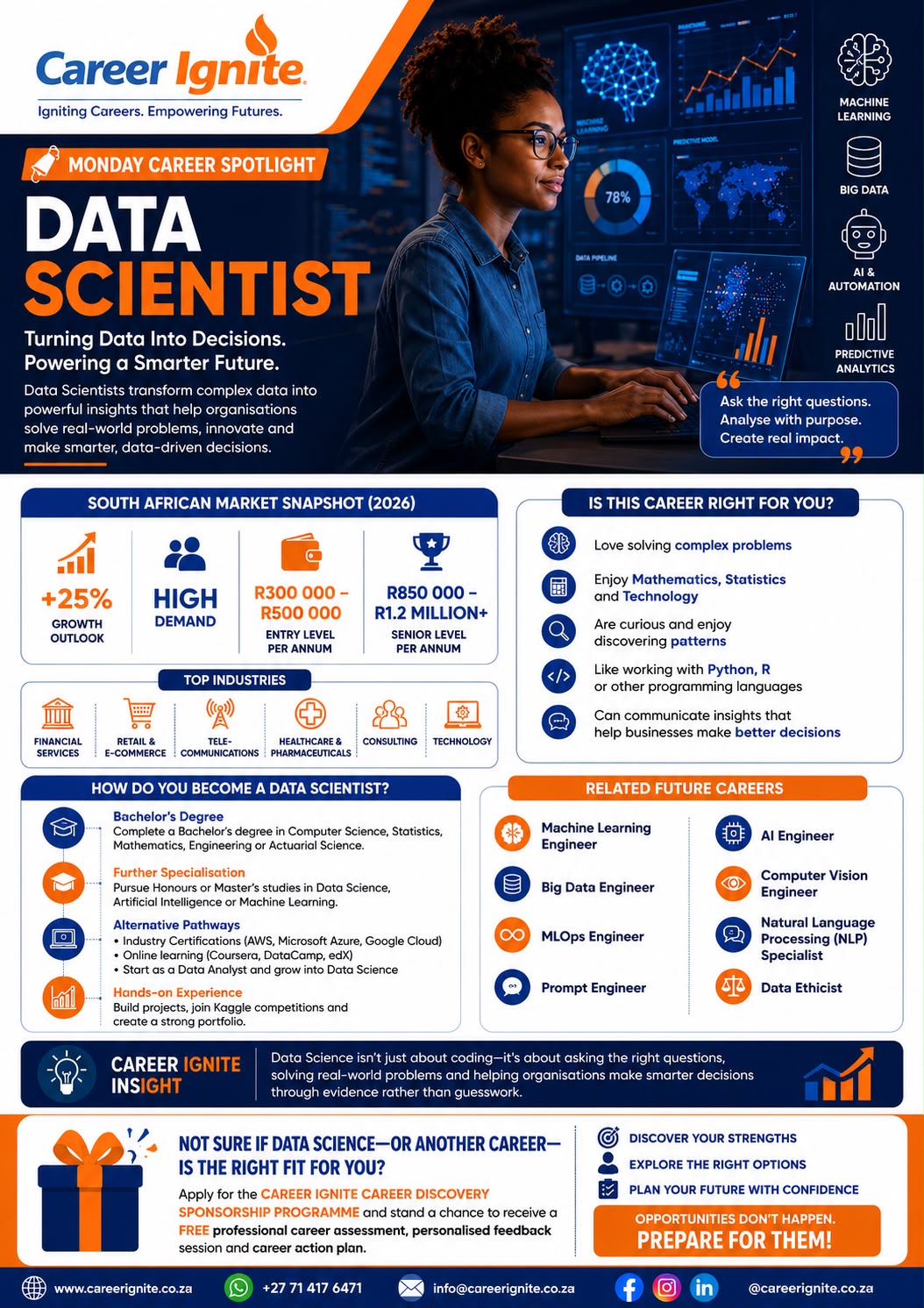
Discover how data scientists combine statistics, computing and subject knowledge to investigate questions and build data-driven solutions.
Read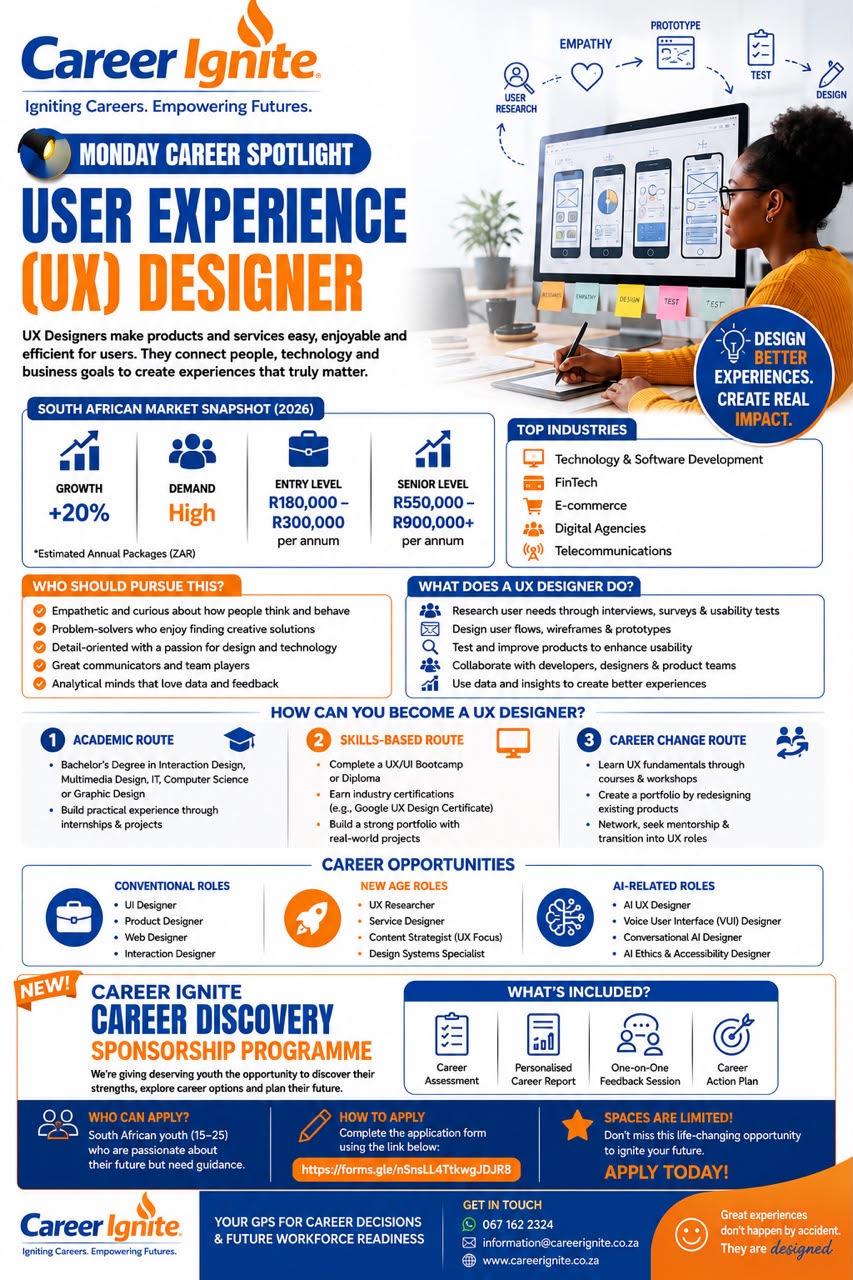
Discover how UX designers research users, test ideas and make digital products easier and more meaningful to use.
Read