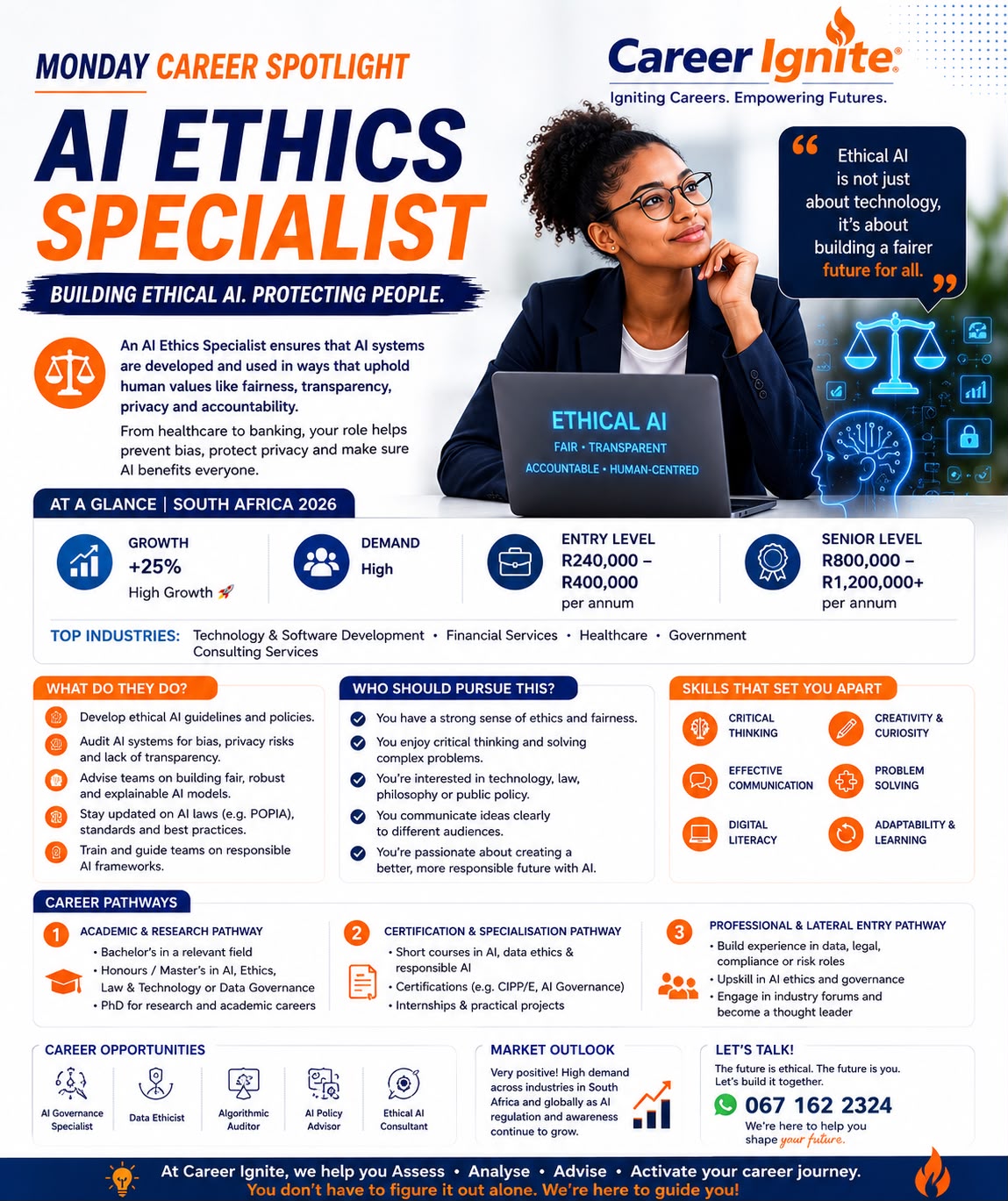
Artificial intelligence can influence who receives an opportunity, how a risk is assessed and what information people see. An AI ethics specialist helps organisations examine whether AI systems are fair, transparent, lawful, safe and accountable. The goal is not to stop innovation, but to make innovation more responsible.
What does this professional do?
- Assesses AI systems for bias, privacy, safety and human-rights risks.
- Develops responsible-AI policies, controls and review processes.
- Works with technical, legal, risk, compliance and business teams.
- Documents how systems are developed, tested, approved and monitored.
- Helps employees understand appropriate AI use and escalation procedures.
Could this career suit you?
This emerging field can suit people who care about fairness and enjoy examining difficult questions from more than one perspective. Clear reasoning, courage, diplomacy and communication are important because ethical decisions often involve competing interests rather than one simple answer.
Helpful school subjects
Languages, Mathematics, Information Technology, History, Life Sciences, Business Studies and related humanities subjects can all contribute. The best combination depends on whether the learner intends to approach the field through technology, law, philosophy, public policy, risk or social science.
Study and development routes
Possible foundations include computer science, data science, law, philosophy, ethics, public policy, sociology, psychology, governance, compliance or risk management. Additional learning in privacy, algorithmic bias, AI governance and impact assessment can build specialisation. UNESCO’s global AI ethics framework emphasises human rights, dignity, transparency, fairness and human oversight.
South African career outlook
Employers may advertise this work under titles such as responsible AI specialist, AI governance specialist, model risk analyst, data ethicist, algorithm auditor, technology policy advisor or privacy specialist. Opportunities are likely to be multidisciplinary, and entrants may first build experience in technology, legal, research, compliance or risk roles.
Related careers to explore
AI Governance Specialist; Data Ethicist; Algorithm Auditor; Technology Policy Advisor; Privacy Specialist; Model Risk Analyst; Responsible AI Consultant.
Career Quest question
Would you enjoy helping organisations answer not only ‘Can we build it?’ but also ‘Should we, and how can we protect people?’
Sources and editorial references
- UNESCO: Recommendation on the Ethics of Artificial Intelligence. https://www.unesco.org/en/artificial-intelligence/recommendation-ethics
Editorial note: precise salary and growth figures have deliberately not been published as facts without a named, dated source. Career opportunities and admission requirements change; readers should verify current information with employers and institutions. Information reviewed 29 August 2026.
Laiqah Bowers-Charles
Founder & CEO, Career Ignite
- • Certified Career Counsellor
- • Certified Career Assessment Practitioner
- • 25+ Years HR & Human Capital Leadership
Not sure whether this is your best-fit career?
A career should not be selected only because it appears exciting, pays well or is described as “in demand”. Career Ignite helps learners explore the relationship between their interests, personality, abilities, motivators and possible career environments.
Related articles
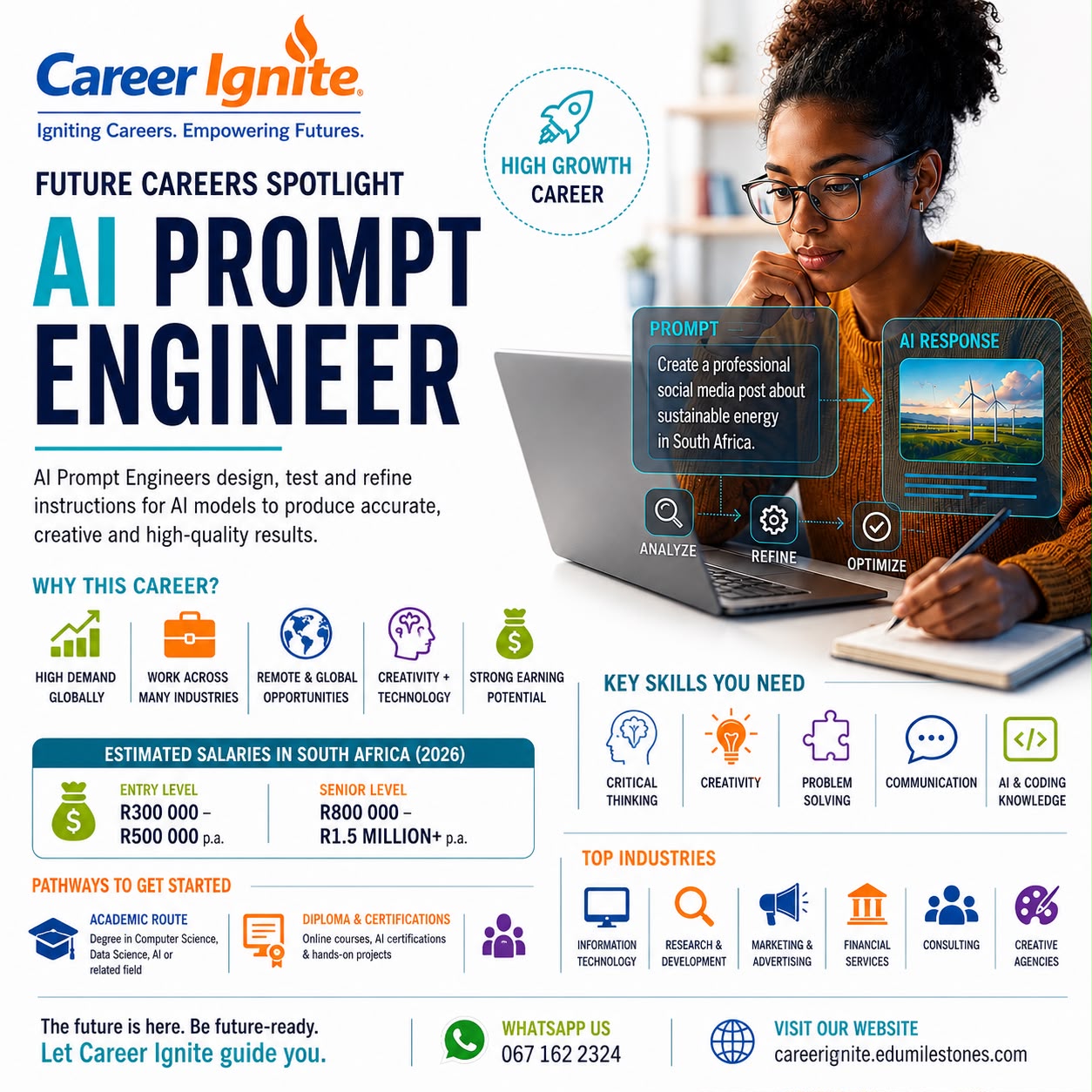
Understand prompt engineering, the work behind reliable AI outputs and why this capability is increasingly combined with broader professional expertise.
Read
Learn how cybersecurity professionals protect systems and data, respond to threats and build safer digital environments.
Read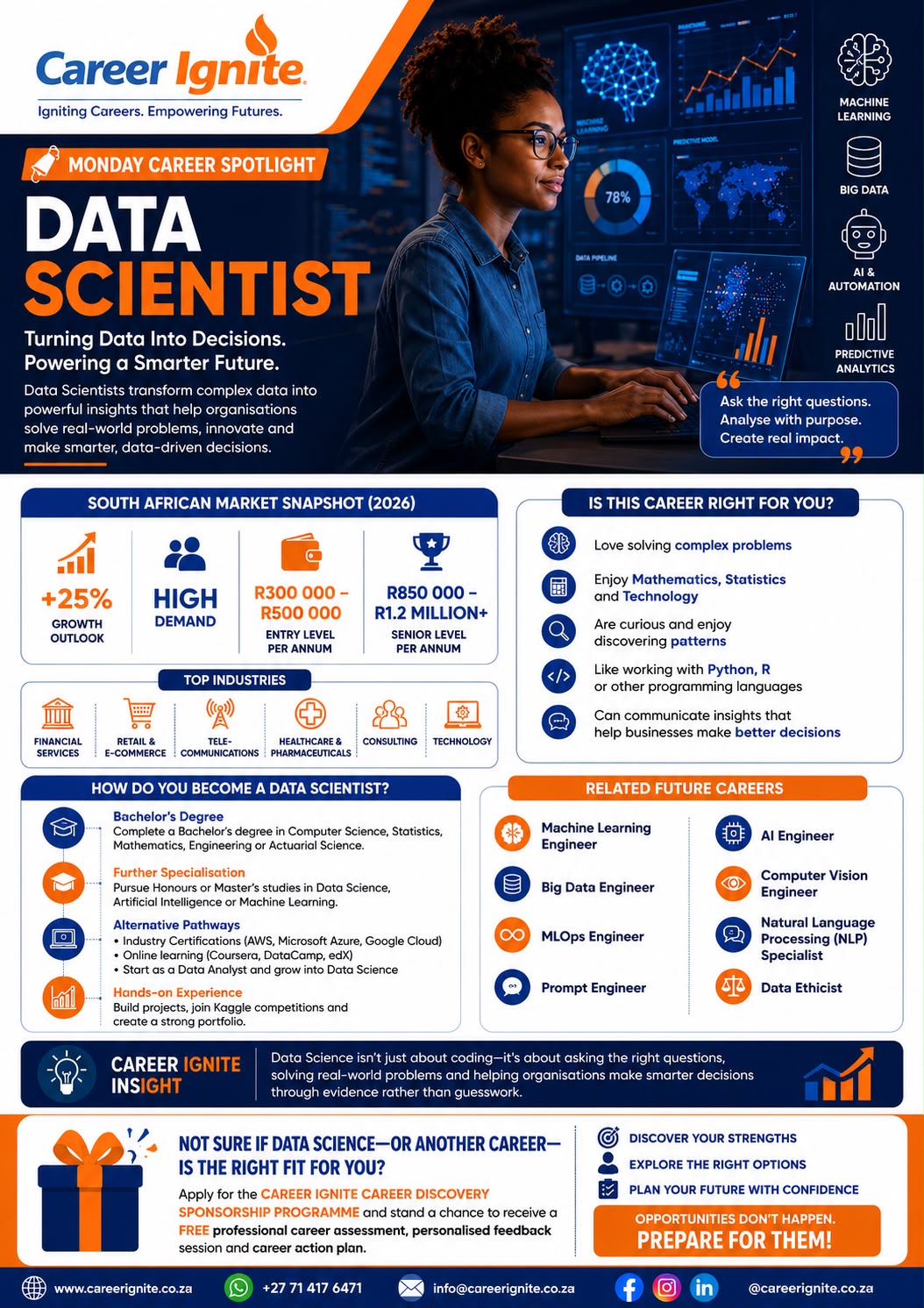
Discover how data scientists combine statistics, computing and subject knowledge to investigate questions and build data-driven solutions.
Read